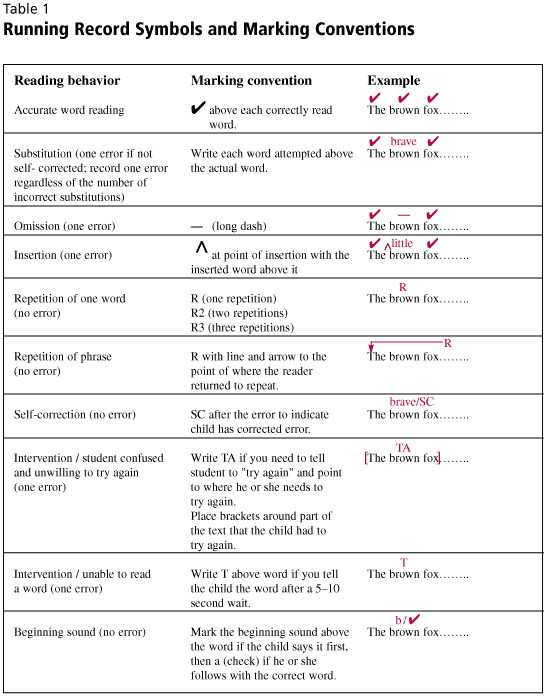
When you perform a running record, simply use the symbols and marking conventions explained in Table 1 below to record a child’s reading behavior as she or he reads from the book. When the session is complete, calculate the reading rate, error rate, and self-correction rate, and enter them in the boxes at the bottom of the page. For more information, see Analyzing and Scoring.
Before using the running record form, familiarize yourself with the following terms:
- Errors (E)--Errors are tallied during the reading whenever a child does any of the following:
--Substitutes another word for a word in the text
--Omits a word
--Inserts a word
--Has to be told a word
- Self-correction (SC)--Self-correction occurs when a child realizes her or his error and corrects it. When a child makes a self-correction, the previous substitution is not scored as an error.
- Phonics--The reader uses phonics to decode the words being read. Phonics skills vary by age, grade, and instruction. Younger readers may not have experience with long vowels and may read all words with a short vowel sound. This should be noted so the teacher knows this child is ready for long vowel phonics lessons.
- Morphology--Morphemes are the smallest units of words that have meaning and cannot be divided further. The most common mophemes are root words and affixes. A reader may use their knowledge of a word root and affixes to determine the pronunciation and meaning of the word read.
- Guessing - Some readers use this skill when they are attempting to read very quickly or if they have developed a habit of skimming as they read. For instance, if the word is ran but the reader says ‘runned’, this would indicate the reader is not attending to the graphemes in the word but rather trying to make sense as they read. Or, the reader does not know the word and rather than attempt to decode makes a guess.